
Why Patients in Virginia Talk about Tooth Meridians with Biological and Holistic Dentists
Across Virginia, more patients than ever are seeking a holistic dentist or biological dentist because they are looking beyond symptom-based dentistry. Many have experienced chronic inflammation, autoimmune conditions, TMJ pain, airway or sleep concerns, or sensitivity to dental materials—and they want care that recognizes the mouth–body connection. Patients looking for natural dentistry intuitively feel that their mouth is connected to their overall health. They may notice that dental issues seem to coincide with fatigue, inflammation, autoimmune symptoms, headaches, digestive problems, or chronic stress. Patients traveling from Richmond, Charlottesville, Northern Virginia, Washington DC, and Maryland frequently ask whether specific teeth may relate to systemic stress or chronic health patterns. This lived experience often leads people to explore concepts such as tooth meridians and tooth meridian charts.
Tooth meridian charting provides a framework for education and conversation, while all clinical decisions remain grounded in modern diagnostics and evidence-based care. Tooth meridian theory originates from Traditional Chinese Medicine (TCM) and integrative medical traditions that view the body as an interconnected system rather than isolated parts. In these systems, the teeth are not seen as standalone structures, but as part of broader functional pathways—called meridians—that relate to organs, tissues, and physiological processes throughout the body.
In modern biological dentistry, tooth meridians are not used as a diagnostic replacement for clinical dentistry or medicine. Instead, they are used as an educational and integrative framework, helping patients and clinicians think more holistically about inflammation, healing capacity, and systemic balance—while still grounding care in evidence-based diagnostics and treatment planning.
This page explains:
-
What meridians are and where the concept comes from
-
What a tooth meridian chart represents
-
How biological dentists interpret and responsibly use tooth meridians
-
Benefits, limitations, and common misconceptions
-
A practical overview of tooth-to-meridian groupings
-
How meridian concepts fit into modern oral–systemic science
What are meridians?
In Traditional Chinese Medicine, meridians are described as functional pathways through which life energy (Qi), blood flow, and information circulate throughout the body. Classical TCM identifies 12 primary meridians, each associated with an organ system (such as Lung, Large Intestine, Stomach, Spleen, Heart, Small Intestine, Bladder, Kidney, Pericardium, Triple Heater/San Jiao, Gallbladder, and Liver).
Unlike nerves or blood vessels, meridians are not discrete anatomical tubes. Instead, they represent functional networks that describe relationships between tissues, organs, and physiological processes.
Modern research has explored whether these pathways may correlate with connective tissue planes, fascia, or measurable biophysical properties.
Langevin, The Scientific Basis of Acupuncture describes how acupuncture points and meridian pathways may relate to connective tissue signaling and mechanotransduction rather than mysterious or purely energetic structures.
Similarly, Longhurst, Defining Meridians explains meridians as integrated physiological response systems, involving neurological, vascular, endocrine, and connective-tissue components.
From this perspective, meridians function as communication maps rather than physical structures—an idea that aligns well with how biological dentistry views the mouth as part of a larger biological network.
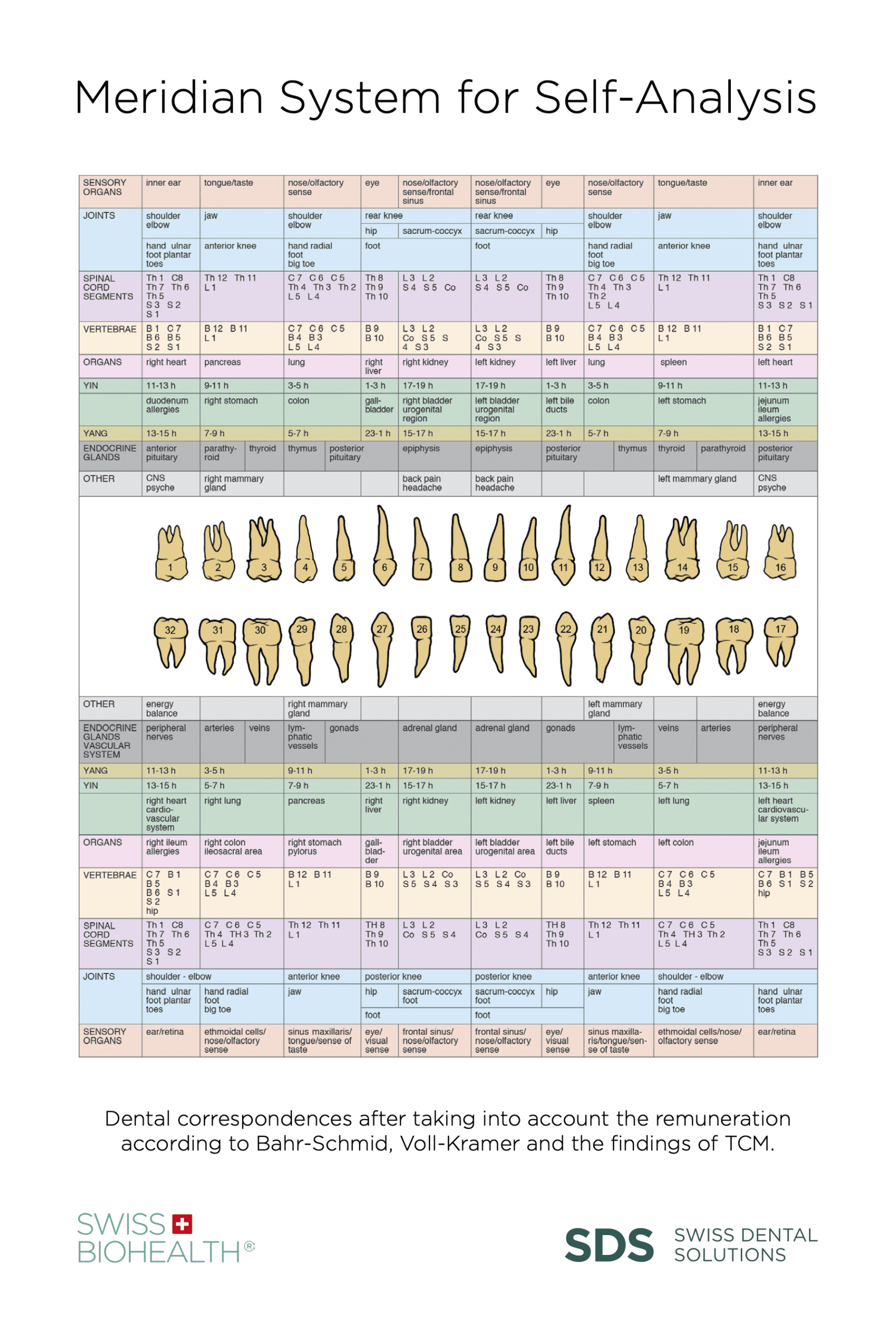
What is a tooth meridian chart?
A tooth meridian chart applies meridian theory specifically to the teeth. Each tooth—or group of teeth—is associated with one of the body’s meridian systems. These charts are commonly used in holistic dentistry, biological dentistry, and integrative dental education.
The purpose of a tooth meridian chart is not to claim that a single tooth causes disease in a specific organ. Rather, it offers a framework for understanding patterns, stress relationships, and systemic conversations within the body.
Professional dental education publications describe tooth meridians as an adjunctive, educational concept, not a diagnostic tool.
Dimensions of Dental Hygiene, Understanding Tooth Meridians explains how tooth meridians are discussed within holistic dental models and emphasizes their role in patient education and integrative thinking.
Where tooth meridian theory comes from
Tooth meridian charts commonly used today draw from several overlapping traditions:
-
Traditional Chinese Medicine
-
European biological medicine
-
Electroacupuncture and energetic assessment systems
-
Holistic dental philosophies developed over the last century
These traditions emphasize systems biology—the idea that chronic stress or inflammation in one area of the body can influence other areas through immune, neurological, vascular, or connective-tissue pathways.
While different charts may assign teeth slightly differently, the core principle remains consistent: the mouth is deeply connected to the rest of the body.
Tooth meridians and modern oral–systemic science
Even without meridian theory, modern medicine increasingly recognizes that the mouth is not biologically isolated.
Chronic oral inflammation—particularly periodontal disease—has been associated with systemic inflammatory conditions. The American Heart Association, Periodontal Disease and Cardiovascular Risk scientific statement discusses biologically plausible mechanisms linking gum disease with cardiovascular disease, including inflammatory mediators and immune activation.
From a biological dentistry perspective, tooth meridians complement—not replace—this understanding by offering a systems-based language that resonates with many patients seeking integrative care.
Why biological dentists in Virginia reference tooth meridians
Virginia is home to a growing population of patients interested in functional medicine, integrative healthcare, and biological dentistry. These patients often want dentistry that:
-
Uses biocompatible materials
-
Addresses chronic inflammation
-
Respects airway and overall system health
-
Considers the systemic impact of oral conditions
Tooth meridians fit into this philosophy by reinforcing a key principle: the mouth influences the body, and the body influences the mouth.
At the same time, responsible biological dentists in Virginia clearly communicate that tooth meridian charts:
-
Do not diagnose organ disease
-
Do not replace medical evaluation
-
Are used for education and context only
How biological dentists responsibly use tooth meridians
In a modern biological dental practice, tooth meridians may be used in the following ways:
1. As an educational tool
Meridian charts can help patients visualize how oral health fits into overall wellness. This can improve engagement, compliance, and understanding—especially for patients who feel unheard in conventional settings.
2. To support whole-body conversations
If a patient presents with chronic inflammation, recurrent infections, or unexplained symptoms, meridian frameworks may prompt broader health history questions and interdisciplinary collaboration.
3. To encourage prevention-focused care
Patients often become more motivated to address gum health, airway issues, nutrition, stress, and sleep when they understand the mouth as part of a larger system.
Importantly, responsible biological dentists do not diagnose organ disease based on teeth and do not delay necessary medical care based on meridian interpretations.
Benefits and limitations of tooth meridian charting
Potential benefits
-
Encourages systems thinking and patient awareness
-
Supports integrative and preventive care philosophies
-
Aligns with patient experiences of whole-body symptoms
-
Enhances communication between dental and medical providers
Limitations and challenges
-
Tooth meridian charts are not standardized
-
Scientific evidence for one-to-one tooth–organ causation is limited
-
Over-interpretation can cause unnecessary fear if not handled carefully
Research exploring the physiological basis of meridians continues, including studies on connective tissue and biophysical signaling.
Maurer, Anatomical Evidence of Acupuncture Meridians and Li, Biophysical Characteristics of Meridians examine potential measurable correlates—but they do not establish diagnostic tooth-organ relationships.
Tooth meridian chart overview (educational)
Below is a commonly referenced grouping system used in holistic dentistry education. Exact mappings may vary slightly by chart and tradition.
Incisors (front teeth)
Often associated with Kidney / Bladder meridians
Themes discussed: vitality, fluid balance, foundational energy
Canines and lateral incisors
Often associated with Liver / Gallbladder meridians
Themes discussed: detoxification, tension, emotional stress
Premolars
Often associated with Lung / Large Intestine meridians
Themes discussed: immunity, respiration, elimination
Molars
Often associated with Stomach / Spleen–Pancreas meridians
Themes discussed: digestion, nutrient assimilation, metabolic balance
Wisdom teeth
Often associated with Heart / Small Intestine / Triple Heater meridians
Themes discussed: regulation, circulation, adaptive stress
These groupings are presented for education only and should never replace clinical evaluation.
Tooth meridians, pain, TMJ, and healing support
Meridian-based therapies such as acupuncture have been studied as adjunctive approaches for pain management and temporomandibular disorders.
A systematic review, La Touche, Acupuncture for Temporomandibular Disorders, found evidence supporting acupuncture’s role in reducing pain and muscle tension in TMJ patients when used appropriately.
In biological dentistry, such approaches may complement dental treatment by supporting nervous system regulation and patient comfort—without replacing conventional care.
What patients in Virginia should understand
Tooth meridian charts are best viewed as:
-
Conversation starters, not diagnoses
-
Educational frameworks, not medical tests
-
Integrative tools, not replacements for imaging or exams
If you experience:
-
Dental pain, swelling, bleeding gums
-
Chronic fatigue, unexplained inflammation, or systemic symptoms
You should always seek evaluation from qualified dental and medical professionals.
Ready to Discuss Your Oral Health with a Biological Dentist?
Let’s create a personalized path to wellness—starting with your mouth and your work with our holistic dentist. Schedule your biological dentistry consultation today and take the first step toward a longer, healthier life from the inside out. If you need further assistance or have specific questions, feel free to ask!


