
All-on-6 dental implants replace a complete upper or lower arch with a fixed prosthetic bridge supported by six strategically placed ceramic implant fixtures, while full-mouth treatment may involve separate reconstruction of both arches with an individually confirmed number of implant supports.
At Virginia Biological Dentistry, Dr. Olivia Hart performs All-on-6 restorations with ceramic (zirconia) implants as part of our metal-free approach. Six implants relate to a single arch; treating both jaws means two independent reconstructions. Whether extractions are needed, how many implants your anatomy supports, and whether a fixed temporary bridge is delivered the same day as surgery are decided after diagnostics in Glen Allen, VA.
In an All-on-6 restoration, six implant fixtures positioned within one jaw support a fixed prosthetic bridge spanning the dental arch. The name refers to the number of implants, not teeth — the bridge above them typically holds 10 to 12 prosthetic teeth. “Plus” refers to cases where the final ceramic implant count exceeds six. When anatomy, bone distribution, or restorative design calls for it, Dr. Hart may plan seven or more implants in an arch if justified for the optimal clincal outcome.
All-on-6 is considered when problems affect most of one arch and restoring individual teeth would not create a predictable foundation for a fixed reconstruction. Common situations:
At your first evaluation, Dr. Hart examines each tooth, both arches, gum health, active infections, bone volume, bite forces, medical history, medications affecting healing, smoking, bruxism, and hygiene capacity under a fixed bridge. You leave with a written plan showing which teeth can be preserved, a separate decision per arch, the implant count your anatomy supports, any pre-treatment needed, whether same-day fixed temporary is realistic, and the timeline to definitive placement.
Three directions can result: preserving your natural teeth with ceramic crowns and bridges, full-arch implant restoration, or a hybrid combining both.
| Option | What it restores | Fixed or removable | When it's considered |
|---|---|---|---|
| Single ceramic implant | One missing tooth | Fixed | Isolated tooth loss with healthy neighbors |
| Ceramic crowns and bridges | Damaged teeth restored, gaps bridged over anchors | Fixed | Most natural teeth still viable |
| Removable denture | Full arch or partial | Removable | Interim option or surgery declined |
| All-on-4 dental implants | Full arch on 4 implants | Fixed | Anatomy allows load on 4 fixtures |
| All-on-6 dental implants | Full arch on 6 implants | Fixed | Larger surface distributes load |
| All-on-6 plus | Full arch on 6+ implants | Fixed | Design calls for additional support |
Four, six, or more implants — the choice comes from bone distribution, arch shape, and force distribution, not from a universal preference.
Resolvable limitations — active gum disease, untreated infection, insufficient bone — are addressed first with periodontal therapy, extractions, and bone regeneration using PRF and grafting. Risk factors that change the plan include smoking, uncontrolled bruxism, unstable diabetes, and medications suppressing bone remodeling. Situations requiring medical clearance — recent jaw radiation, uncontrolled cardiovascular disease, or high-risk systemic conditions — are usually addressed through coordination with your physician.
Everyday function. The bridge stays fixed while you eat, speak, and sleep — no removal, no adhesive. Chewing force travels through the implants into the jaw rather than resting on soft tissue the way a denture plate does.
One coordinated design. Prosthetic tooth position, arch shape, bite, speech articulation, and cleaning access are drawn as one system, so function is set intentionally. Chewing returns to a functional range for most patients.
Zirconia as the material. We use zirconia (ceramic) implants and a ceramic bridge as part of our metal-free approach. Zirconia blends more naturally at the gumline than metal fixtures. Implant and bridge are separate components with different service lives, replaced independently if needed.
A fixed full-arch restoration requires regular professional maintenance because tissue health around implants depends on cleaning access you can’t fully manage alone. Implants and the bridge have different service lives — over time the bridge may need adjustment while the implants stay in place. Function depends on gum health, bite balance, nightguard use, and recall visits.
From your first diagnostic visit to the seating of your final ceramic bridge, both the surgical and prosthetic phases stay with Dr. Hart. The plan you agree to at the start is the plan she executes.
We document each remaining tooth, tissue condition, and existing prosthetics. Cone-beam 3D imaging (Planmeca ProMax 3D Plus) maps jawbone shape, density, sinus proximity, and nerve position. Digital impressions capture both arches; bite analysis records signs of overload. You leave with a clinical decision for each arch — All-on-6 proceeds, or a different direction is explained.
Dr. Hart designs your case on 3D software using X-Guide navigation. Implant positions are chosen so chewing load lands within the strongest available bone; the future bridge is drawn over that layout. You leave with a written plan showing implant count, temporary strategy, additional procedures, and full price.
Surgery includes extractions of hopeless teeth, targeted PRF from your own blood, bone grafting where needed, and placement of ceramic implants under local anesthesia —consious sedation or full sedation are available. Temporaries to enhance stability and healing of the full mouth of implants are delivered the same or next day.
Over four-five months, the ceramic implants biologically bond to your jawbone. Follow-ups check integration and tissue healing; the temporary bridge serves as feedback for the final restoration design.
A try-in confirms tooth position, arch form, midline, and lip support before the definitive ceramic bridges are fabricated. You approve the shape of your teeth before permanent fixation. Final placement seats the bridge and refines occlusion; you leave with a maintenance schedule, and a nightguard fitting if indicated and scheduled biological hygiene cleaning at our office to maintain health of your gums
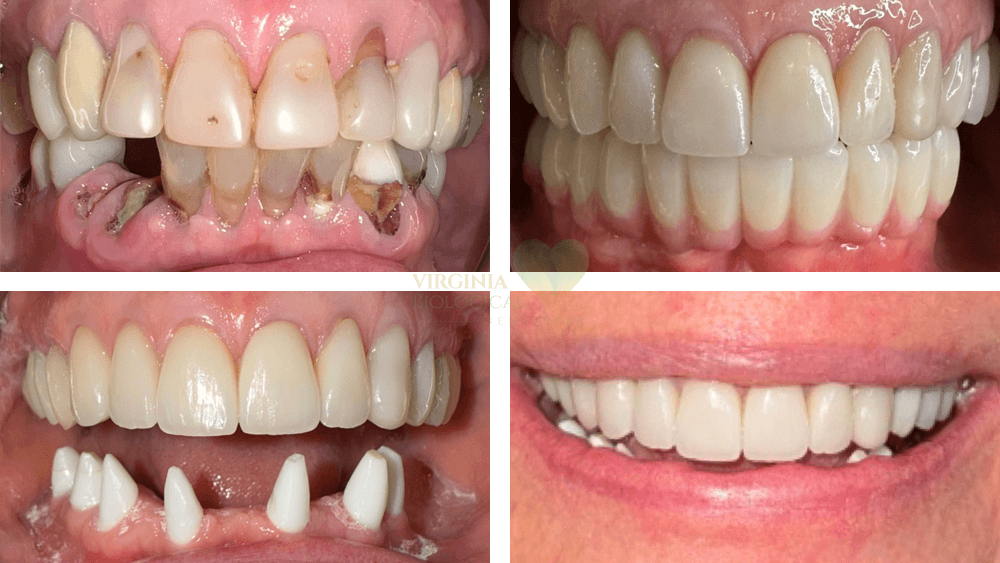
This case used seven ceramic implants in the lower arch because Dr. Hart’s final plan called for an additional support point. The number of implants in a full-arch reconstruction may differ from the standard six when anatomy and design require it.
Starting condition. Gross decay across most upper teeth; active infections in every lower tooth.
Clinical decision. Upper arch saved with porcelain veneers and ceramic crowns; lower arch required full extraction under our biological protocol.
Restorations placed. Lower teeth extracted, PRF applied, bone grafting where indicated, seven ceramic implants placed immediately, fixed temporary bridge attached the same day.
Verified result. Osseointegration confirmed at four months; permanent ceramic bridges seated. Chewing restored, infection resolved. Stable at follow-up.
The full single arch package with all on 6 plus non-metal dental ceramic implants with biological extractions and final permanent ceramic restorations cost ranges from $59,000-$67,000 depending on the complexity of the cases.
The package price includes 3D imaging and planning, ceramic implants, abutments, temporary and definitive bridges, guided surgery, planned extractions, PRF harvesting, bone grafting, , and post-operative adjustments. Items outside baseline are quoted per unit or per procedure.
Virginia Biological Dentistry is out of network with every dental insurance plan. You pay the practice directly; our team files your claim as a courtesy, and reimbursement is determined by your policy.
Recovery unfolds on three overlapping timelines: active recovery from surgery (a few days), soft-tissue healing (a few weeks), and osseointegration of the ceramic implants into your jawbone (four months on average). Discomfort is concentrated at the start; the longer period is internal bone healing you don’t feel and that doesn’t restrict daily life.
Local anesthesia wears off within hours; prescribed pain management should begin before that. Discomfort and swelling peak on days two and three, then fade through the first week.
Nutrition transitions in phases: liquids at room temperature for 24–48 hours, soft foods for the first week, then soft chewing while implants integrate. Return to full chewing waits until Dr. Hart confirms integration — absence of pain doesn’t mean osseointegration is complete.Soft food diet is a must during 4 months of healing.
Cleaning starts gently and increases as tissues heal — technique is demonstrated in the office. Professional biological hygiene visits with our team familiar with ceramic full-arch restorations are essential . A nightguard is fabricated if you grind.
At our Glen Allen, VA office, full-arch ceramic implant work sits at the intersection of oral surgery, implant prosthodontics, and biological materials selection.
A comprehensive examination with Dr. Hart tells you whether All-on-6 fits your case, the exact price for your plan, and the timeline from surgery to your final bridge. Call (804) 381-6238 to schedule at our office in Glen Allen, VA.
We are pleased to welcome you to Virginia Biological Dentistry, where you can find metal-free restorations, offering a more holistic solution. To get started, call us at phone (804)381-6238 and schedule an appointment.
The prosthetic bridge is thinner than a full denture and doesn’t cover the roof of your mouth. Most patients adjust within a few weeks as the tongue adapts to the new tooth position.
No. Unlike a conventional upper denture, an All-on-6 bridge is supported by the ceramic implants only, so the palate stays uncovered and normal taste, temperature sensation, and speech are preserved.
Sometimes yes. When natural gum contour has receded — common after long denture wear or bone loss — the bridge is designed with a small strip of pink ceramic at its base to recreate the gumline. Whether your case needs this is decided during planning and shown to you at try-in.
A small gap exists by design between the bridge and gum tissue so you can clean underneath. Food doesn’t trap under a well-fitted bridge, but plaque accumulates if cleaning is skipped.
The prosthetic teeth cannot get cavities — ceramic doesn’t decay. The gum and bone around the implants can develop peri-implant inflammation, driven by the same causes as natural-tooth gum disease.
Early failure of a single implant is uncommon. If one doesn’t integrate, it is removed, the site heals, and a replacement is placed later while the remaining implants continue to support the bridge.
You feel chewing pressure normally — ceramic implants transmit force through bone the way natural roots do. Temperature sensation through the teeth is muted because ceramic doesn’t conduct heat and cold like enamel.
Yes. Zirconia ceramic implants are non-metallic — they don’t trigger airport metal detectors, don’t interfere with MRI imaging, and don’t create artifacts


