
For generations, dentistry and medicine operated in separate spheres—two professions, two philosophies, two distinct ways of understanding health. Yet modern science, combined with decades of clinical experience in biological dentistry, reveals a very different truth: your mouth is not separate from your body. It is a living extension of every organ system—neurologically, immunologically, metabolically, and even emotionally.
This foundational principle lies at the heart of biological dentistry. At Virginia Biological Dentistry, serving Richmond, Northern Virginia, the Washington DC metro area, Bethesda, Chevy Chase, and Northern Bethesda, our philosophy is grounded in a profound and transformative insight: when the mouth is healthy, the body has the capacity to thrive; when the mouth is inflamed, infected, or burdened with toxins, the entire system carries that weight.
What follows is a narrative exploration of this connection—supported by research, expressed from the clinical perspective of a biological dentist, and written for patients who want whole-body, root-cause, integrative care.
A Living Network: How Every Tooth Communicates With the Brain
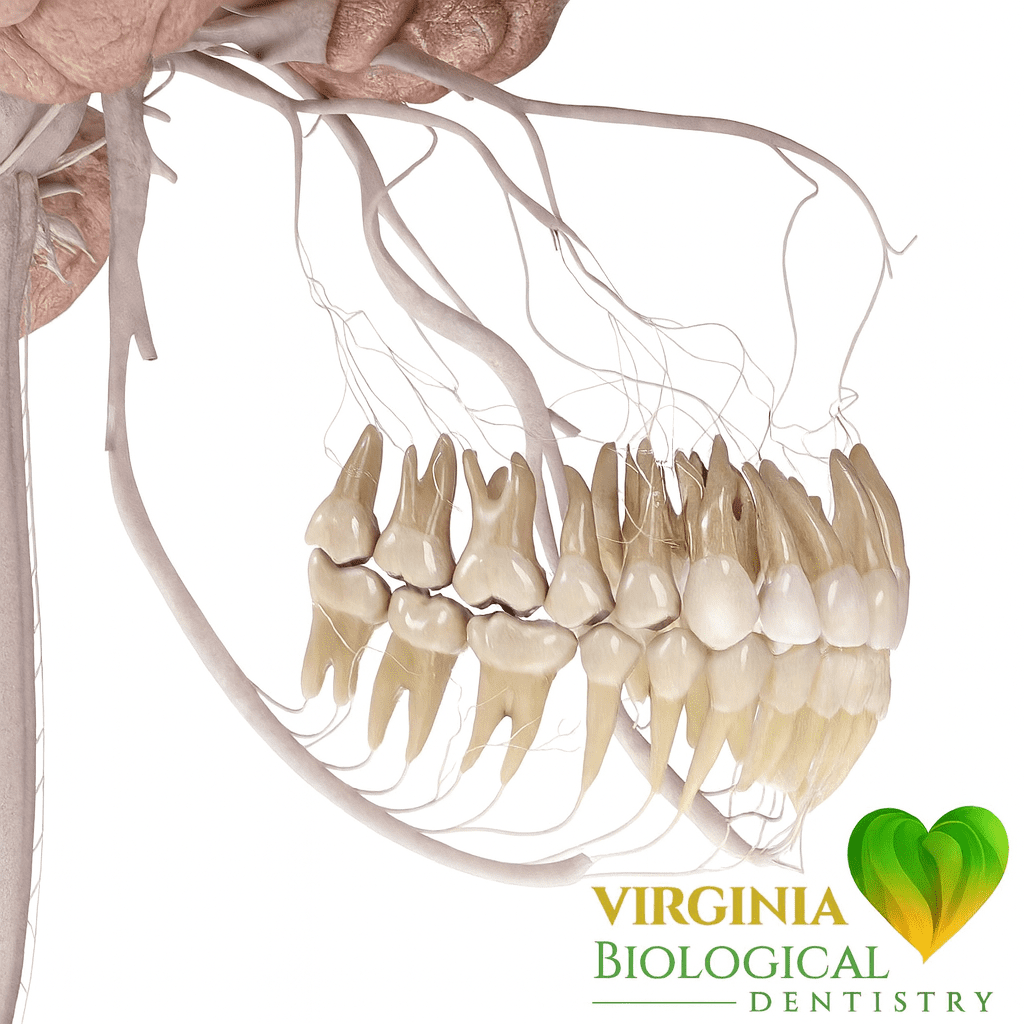
One of the most vivid examples of the mouth–body connection is the trigeminal nerve—the largest and most influential sensory nerve in the head. It serves as the highway between every tooth and the brainstem. When a tooth becomes inflamed or infected, this nerve doesn’t just carry pain; it carries information that can shift the body’s entire regulatory system.
Every tooth is plugged directly into this network. Inside each tooth are thousands of sensory fibers constantly transmitting messages about temperature, pressure, inflammation, and movement. These signals travel through the maxillary or mandibular branches of the trigeminal nerve and straight into the brainstem’s control centers.
When an infection develops, the communication intensifies. Irritated pulpal tissues release inflammatory chemicals and nociceptive signals that surge through the trigeminal pathways. The brain interprets these as high-priority distress messages—because dental infections sit just inches from the brain, sinuses, airway, and critical vascular structures.
As the brainstem receives this amplified stream of inflammatory input, several systems shift accordingly:
-
Autonomic centers react, often increasing sympathetic (“fight-or-flight”) tone.
-
Muscles tighten reflexively in the jaw, neck, shoulders, and temples.
-
Pain pathways become sensitized, heightening headaches, facial pain, or eye pressure.
-
Posture and motor activity change, as trigeminal input alters muscle activation patterns.
-
Stress and sleep can be affected, because the trigeminal system links directly to arousal and regulatory circuits.
These effects are not theoretical—they are well documented in neurological research, including the work of Barry J. Sessle, Mechanisms of Oral Somatosensory and Motor Functions. His research shows that trigeminal sensory pathways influence pain modulation, autonomic function, and even whole-body posture.
From a biological dentist’s perspective, this research puts words to what we see clinically every day: a single inflamed tooth can influence brain behavior and more specifically:
-
A chronically infected tooth can trigger headaches.
-
A failing root canal can amplify systemic inflammation.
-
A hidden abscess can contribute to anxiety, poor sleep, or autonomic dysregulation.
-
A single inflamed molar can alter muscle firing patterns throughout the head and neck.
In other words: A tooth infection is never local. It is neurologically active. It engages the trigeminal nerve. And it can influence the entire body through the brainstem.
Patients from Virginia, DC, and Maryland often arrive with unexplained headaches, facial pressure, ear pain, migraines, or TMJ discomfort—after seeing multiple medical specialists—only to discover the true cause was an irritated nerve inside a chronically inflamed tooth.
The mouth does not whisper to the brain. It speaks through one of the most powerful neural networks in the human body.
When Oral Bacteria Enter the Bloodstream: The Silent Path to Systemic Disease
Bloodstream communication is the second major biological pathway linking oral and systemic health. Every time gums bleed—even slightly—oral bacteria enter circulation.
They don’t remain local.
They migrate.
They colonize distant tissues.
They drive inflammation.
A landmark study by Thomas J. Haraszthy et al., Identification of Periodontal Pathogens in Atheromatous Plaques, 2000, revealed DNA from periodontal pathogens such as Porphyromonas gingivalis inside coronary artery plaque samples.
This finding was groundbreaking: bacteria from the mouth were physically inside the arteries of the heart.
Years later, Peter B. Lockhart et al. published an authoritative scientific statement for the American Heart Association in Circulation Periodontal Disease and Atherosclerotic Cardiovascular Disease, 2012, confirming that periodontal disease contributes to systemic inflammation and cardiovascular risk.
In biological dentistry, these findings are not footnotes. They are clinical reality.
When a patient says, “My gums bleed sometimes, but it’s not serious,” the biological dentist sees a deeper truth:
if your gums are bleeding, the inflammatory load is traveling through the rest of your body.
The Danger of Ignoring Dental Abscesses: When Infection Turns Life-Threatening
A dental abscess is a systemic infection that begins in the mouth. Historically, it was one of the top causes of death. Even today, the CDC reports more than 60,000 hospitalizations annually due to preventable dental infections.
Abscesses can spread into the bloodstream (sepsis), the jaw and throat (Ludwig’s angina), the sinus cavity, or directly to the brain (intracranial abscess).
These are not rare tragedies—they appear in medical literature every year.
From the viewpoint of a biological dentist, the absence of pain is not proof of safety. Many infected teeth—particularly those with failing root canals—are painless yet chronically discharging bacteria into the bloodstream.
This is why biological dentists rely on advanced CBCT imaging, laser sterilization, PRF regenerative techniques, biological extractions and ceramic implant replacement to identify and remove underlying causes of infection: failed or dead tooth.
When infection is resolved, systemic symptoms—fatigue, inflammation, brain fog, joint pain—may dramatically improve.
The body has been freed from a burden it carried for years.
The Oral Microbiome: How the Mouth Influences Gut Health, Immunity, and Systemic Inflammation
The human oral microbiome is one of the most diverse microbial ecosystems in the body, with over 700 species of bacteria living on the teeth, gums, tongue, and soft tissues. These microbial communities are not static or isolated. With every swallow, oral bacteria enter the digestive tract, and while most are harmless or cleared, under certain conditions they survive, translocate, and even colonize downstream sites where they can influence health.
In a comprehensive review titled “The Bacterial Connection Between the Oral Cavity and the Gut Diseases,” Shuhei Kitamoto and colleagues describe a growing body of evidence showing that oral bacteria can spread to the gastrointestinal tract and may contribute to diseases such as irritable bowel syndrome (IBS), inflammatory bowel disease (IBD), and colorectal cancer.
This research confirms what biological dentists observe repeatedly:
-
Oral dysbiosis can become gut dysbiosis.
-
Gum disease contributes to leaky gut, autoimmune flares, and chronic inflammation.
-
Restoring oral microbial balance improves systemic well-being.
From the view of a natural dentist, when the oral microbiome is imbalanced due to periodontal disease, chronic infection, or inflammation, it can seed the gut microbiome with pathogenic microbes. This process can contribute to gut dysbiosis, immune activation, intestinal inflammation, and even predispose to systemic conditions like IBD and colorectal cancer.
This is why, for many patients with chronic digestive discomfort, autoimmune disease, or systemic inflammation, addressing the oral microbial environment often becomes a key part of the healing process—not as a replacement for gastroenterology care, but as an essential piece of the mouth–whole-body health puzzle.
Cardiovascular Health and the Mouth: A Clear, Documented Connection
Among all the mouth–body relationships, the link between oral health and heart health is one of the most widely studied and most consistently supported in medical research. Today, periodontal disease (gum disease) is recognized as a meaningful, independent risk factor for cardiovascular problems — including heart attack and stroke.
This connection is not theoretical. It is grounded in decades of scientific evidence.
One of the most important reports comes from the American Heart Association, published by Lockhart and colleagues in Circulation. Their scientific statement, Periodontal Disease and Atherosclerotic Cardiovascular Disease, explains that people with gum disease have a higher risk of developing heart disease, even when you account for other risk factors like smoking, age, and diabetes. The AHA’s own clinical summary further emphasizes that gum disease is linked with chronic inflammation in the blood vessels and early signs of cardiovascular dysfunction — things like endothelial irritation and arterial stiffness.
But why does this happen?
A growing body of research helps explain the connection. A review by Febbraio et al. describes how bacteria from inflamed gums can enter the bloodstream and trigger immune reactions that contribute to atherosclerosis — the process that underlies most cardiovascular disease. In other words, oral inflammation feeds whole-body inflammation, and the heart feels the impact.
Large population studies confirm this pattern. One study published in BMC Cardiovascular Disorders found that people with periodontitis have a significantly higher risk of coronary heart disease and cardiovascular events, including heart attack.
Together, these findings make the message unmistakable:
-
Oral bacteria can enter the bloodstream when the gums are inflamed or infected.
-
They can stick to damaged areas inside blood vessels.
-
They can fuel inflammation that destabilizes arterial plaque.
This is why holistic dentists increasingly remind patients that a healthy mouth is part of a healthy heart.
And it’s why, at Virginia Biological Dentistry, we view periodontal therapy as far more than a dental cleaning. Reducing gum inflammation is one of the most natural, effective ways to lower the body’s overall inflammatory burden — which supports cardiovascular wellness in a real and measurable way.
When you care for your gums, you’re caring for your arteries. When you calm inflammation in the mouth, you calm inflammation throughout the body.
Chronic Oral Infection, Cancer Development, and Systemic Immunity
A growing body of research shows that chronic oral inflammation is not limited to the mouth. It can influence the immune system, alter tumor environments, and increase the risk of several cancers.
One of the most pivotal scientific contributions comes from Georg K. Kostic and colleagues, whose review “Fusobacterium nucleatum in Colorectal Carcinogenesis was published in Nature Reviews Gastroenterology & Hepatology. Her work highlights how Fusobacterium nucleatum — a bacterium commonly found in periodontal disease — can accelerate colorectal cancer progression, promote tumor growth, and suppress anti-tumor immunity.
One of the most striking scientific illustrations of the mouth–body connection comes from research on Fusobacterium nucleatum, a bacterium frequently found in periodontal disease. See: Fusobacterium nucleatum found in colon cancer tissue—could an infection cause colorectal cancer?
This review highlights early findings showing that F. nucleatum is not merely present—it may actively influence cancer behavior. The bacterium has been associated with:
-
Accelerated tumor progression, as F. nucleatum can promote cellular proliferation and support a tumor-enhancing microenvironment.
-
Immune suppression, including interference with anti-tumor immune responses, allowing cancer cells to evade normal immune surveillance.
-
Pro-inflammatory signaling, which fosters chronic inflammation known to support carcinogenesis.
The presence of this periodontal pathogen in distant colorectal tumors underscores a powerful truth: oral microbes do not stay confined to the mouth. They can travel, seed distant tissues, and influence systemic disease pathways in profound ways. For biological dentists, this research provides yet another example of why comprehensive oral health isn’t cosmetic—it is foundational to whole-body wellness.
This finding was further reinforced by population-level evidence published in the Journal of the National Cancer Institute, that looked at the periodontal disease and cancer risk. The study showed significant associations between long-standing periodontal disease and increased risk of multiple cancers, including gastrointestinal and esophageal cancers.
Together, these publications illustrate a key truth: Cancer thrives in states of chronic inflammation. And the mouth is one of the body’s most common — and most overlooked — sources of persistent inflammation.
This is why biological dentistry takes chronic oral infections so seriously. When biological dentists eliminate hidden infections, disinfect periodontal pockets, restore microbial balance, or replace failing root canals with ceramic implants, they are doing more than restoring oral health — they are removing an inflammatory burden that affects the entire body and supporting the immune system’s ability to function optimally.
The Role of Dental Materials: Why Biocompatibility Matters to a Biological Dentist
The materials placed into the mouth interact with the immune system 24 hours a day. Metals such as mercury, nickel, and even titanium can trigger immune reactions, galvanic currents, and chronic inflammation in susceptible individuals.
Biological dentists prioritize:
-
zirconia ceramic implants (metal-free and bio-inert)
-
BPA-free composites
-
Same-day non-metal, biomimetic ceramic restorations such as overlays, onlays or inlays
-
biocompatibility testing
-
IAOMT-certified safe amalgam removal protocols (SMART)
Patients from Bethesda, Chevy Chase, Northern Virginia, and Washington DC come to us after discovering that removing reactive materials dramatically improves systemic symptoms—fatigue, headaches, dizziness, autoimmune flares, and cognitive fog.
Dental materials are not neutral. They engage with biology. This is why biological dentistry emphasizes compatibility as much as strength.
Airway, Breathing, and Sleep: The Dentistry Connection Medicine Overlooked
Beyond infection and inflammation, the shape of the mouth and jaw influences breathing, airway stability, sleep quality, cardiovascular strain, and cognitive function.
Small jaws, tongue tie, mouth breathing, and malocclusion contribute to sleep apnea—an inflammatory condition that strains the entire body.
Biological dentists use CBCT imaging to examine airway space, nasal cavities, sinus health, and jaw position. The airway is part of dentistry. Breathing is part of wellness. And a biological dentist sees them as inseparable.
A Fully Biological Approach: Treating the Mouth With Respect for the Whole Body
At its core, biological dentistry blends the precision of modern imaging and technology—CBCT, laser therapy, PRF —with the understanding that the mouth is fully integrated with every biological system.
At Virginia Biological Dentistry, we diagnose differently. We treat differently. We think differently.
Patients from Richmond, Glen Allen, Henrico, Short Pump, Northern Virginia, Bethesda, Chevy Chase, and the entire DC metro area choose us because they want care that respects the mouth as part of the human body—not a separate structure to be treated in isolation.
Final Reflections — Your Mouth Tells the Story of Your Body
The mouth is not simply where digestion begins. It is where inflammation begins. Where infection begins. Where immunity is challenged. Where systemic diseases often leave their earliest footprints.
A failing tooth can influence brain function. A periodontal pocket can affect the intestines. A dental abscess can threaten life. A chronic root canal infection can contribute to immune dysfunction.
Understanding these connections is what makes biological dentistry essential for patients seeking preventative, natural, holistic, and whole-body-centered care.
At Virginia Biological Dentistry, we honor the mouth–body connection every day. We help the body heal by starting where it matters most: the beginning of the system—the mouth.
When you heal the mouth, you heal far more than teeth. You support the heart. You support the gut. You support the brain. You support life.


